
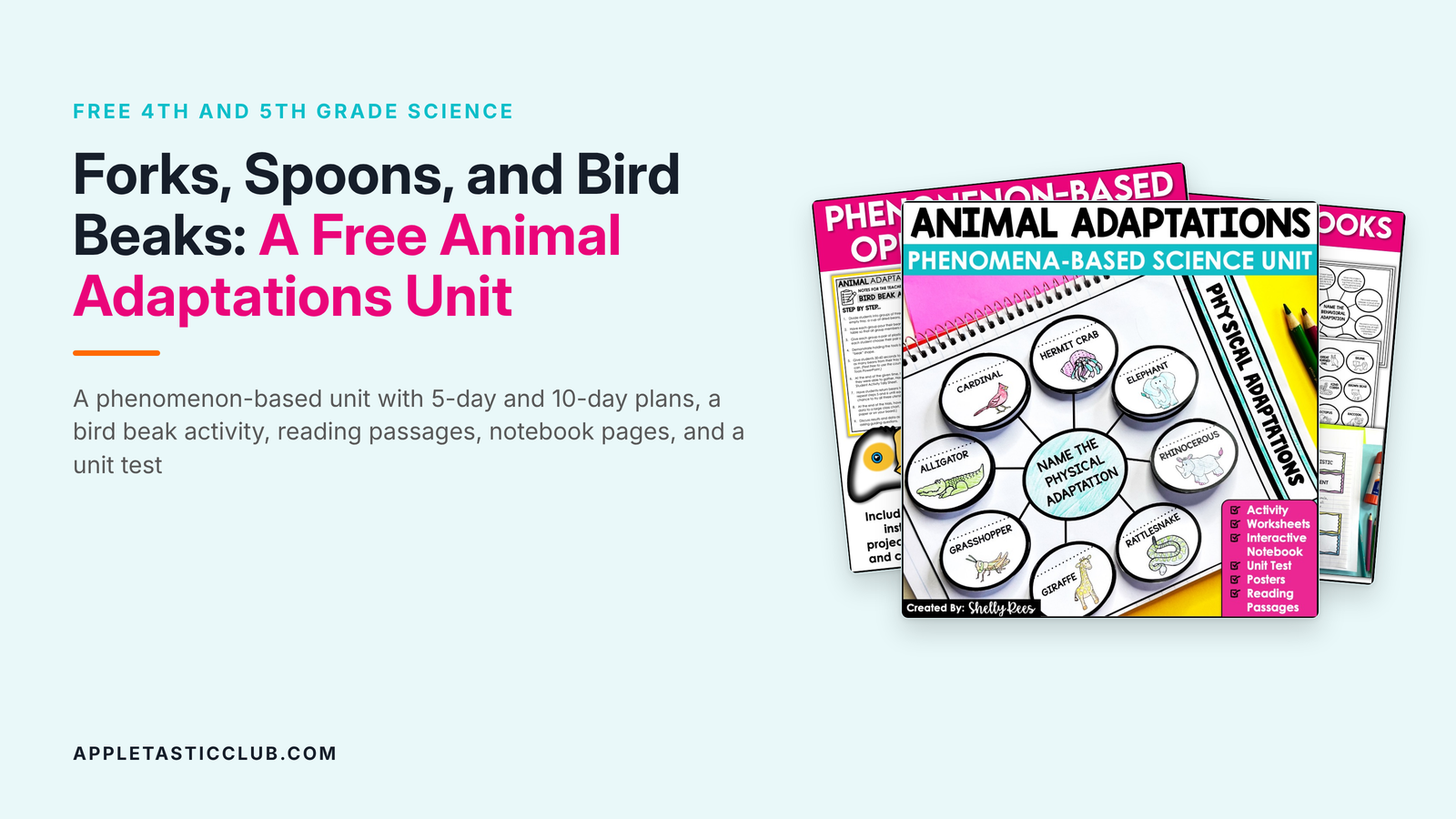
Forks, Spoons, and Bird Beaks: A Free Animal Adaptations Science Unit
Let's be honest, teacher friend. When the week gets crazy, science is usually the first thing to go. Reading and math have to happen, the assembly eats your afternoon, and science slides to "next week" one more time.
This unit is my answer to that week. It's the Animal Adaptations unit from the Appletastic Club, and today it's free: a 61-page printable unit with a 5-day plan and a 10-day plan, plus the Teacher Tools PowerPoint you project while you teach it. Every day is already planned. You print it, grab a cup of dried beans, and go.
Five days or ten, already planned
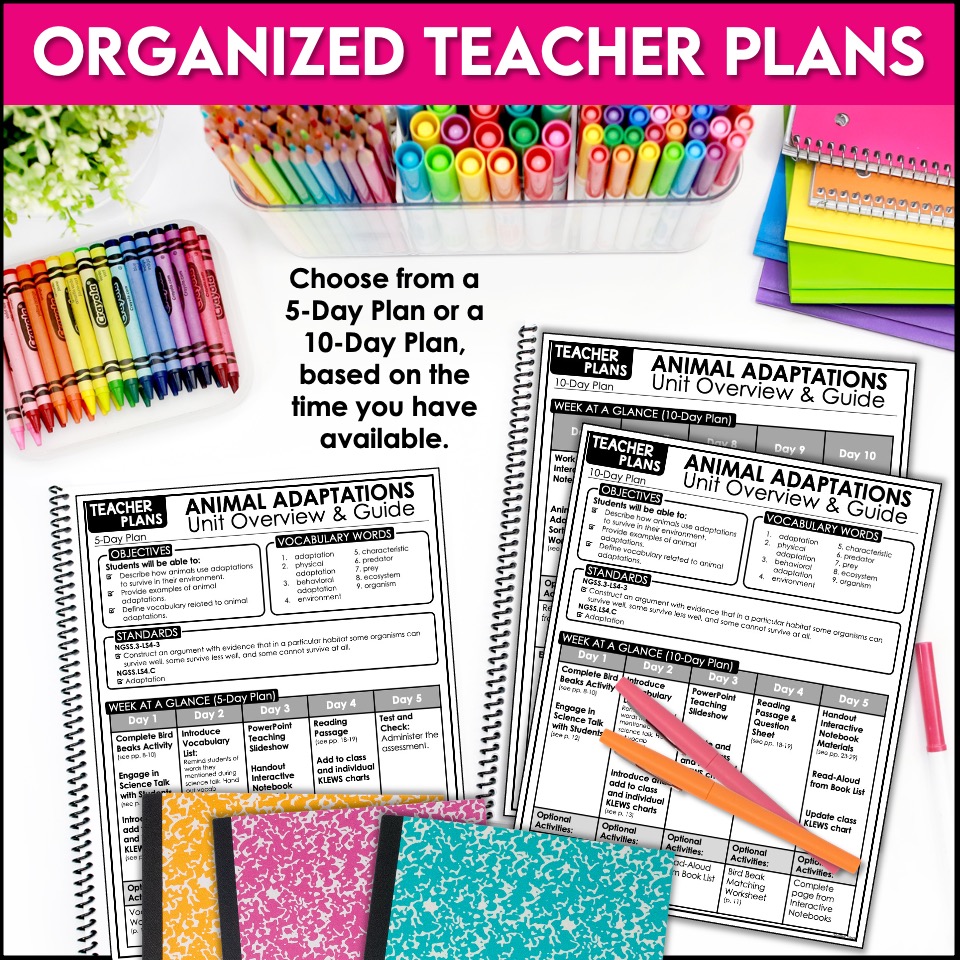
The teacher's guide gives you two versions of the same unit. The 5-day plan moves fast: the driving question and the bird beak activity on day 1, a science talk and vocabulary on day 2, the teaching slideshow and notebook pages on day 3, the reading passage on day 4, and the test on day 5. The 10-day plan slows it down with time for the second reading activity, the adaptations sort, vocabulary review, and finishing the notebooks.
Both plans list the objectives, the nine vocabulary words, and the standard (NGSS 3-LS4-3), with optional activities under each day, like a read-aloud from the suggested books list or a word search. Pick the plan that fits the time you have. You do you.
Day 1: forks, spoons, and a cup of beans
The unit opens with a driving question, "How can animals use adaptations to survive in their environment?", and a photo phenomenon students scan with a QR code and talk about. Then comes the bird beak activity, and this is where I seriously love this unit.
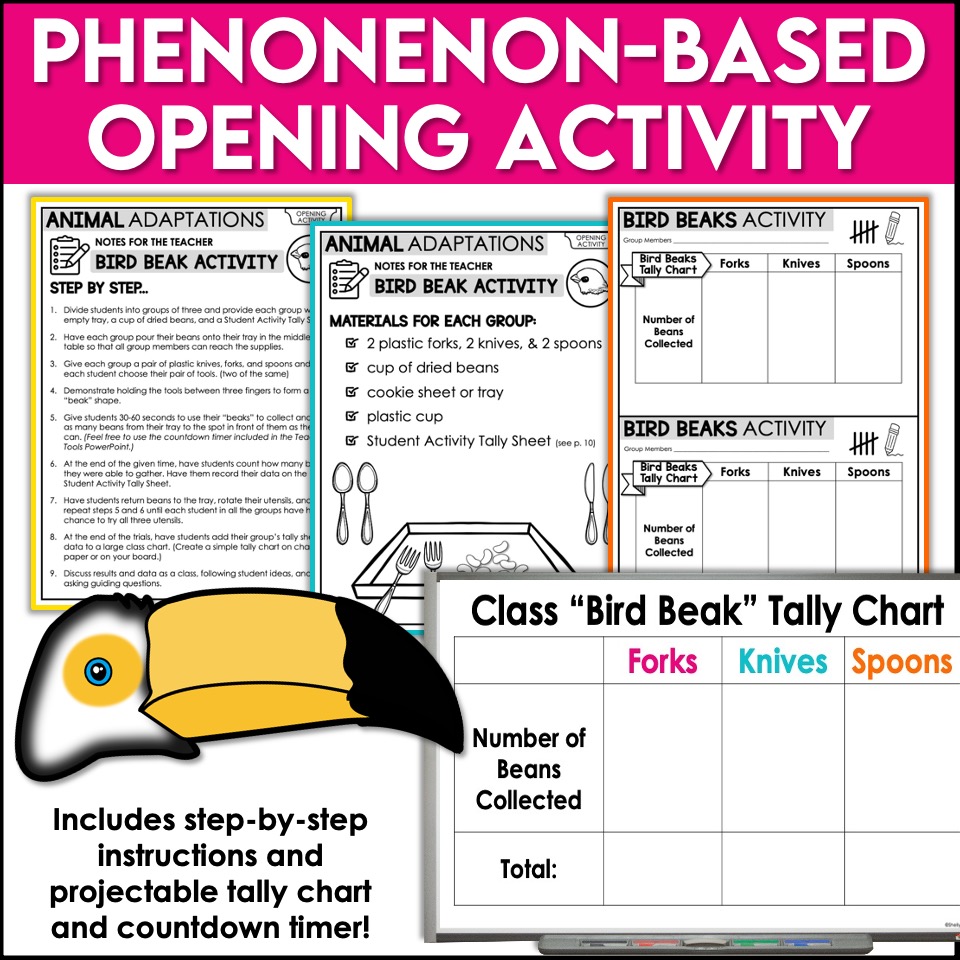
Students work in groups of three with a tray of dried beans and plastic forks, knives, and spoons. Each student holds a pair of the same utensil like a beak, and in 30 to 60 seconds they move as many beans as they can. They count, record it on the tally sheet, trade utensils, and go again until everyone has tried all three. Then the whole class puts its numbers on one chart and talks about why some "beaks" worked so much better than others.
Five tips for the bird beak activity:
- Gather the supplies the week before: per group, 2 plastic forks, 2 knives, 2 spoons, a cup of dried beans, a cookie sheet or tray, and a plastic cup.
- Show students how to hold the two utensils between three fingers to make a beak before anyone starts.
- Use the countdown timer in the Teacher Tools PowerPoint so every round is the same length.
- Project the class tally chart from the Teacher Tools and fill it in together as groups report.
- Follow it with the Bird Beak Matching page: nine birds, from the hummingbird to the pelican, matched to what their beaks do.
A science talk, a KLEWS chart, and a CER template
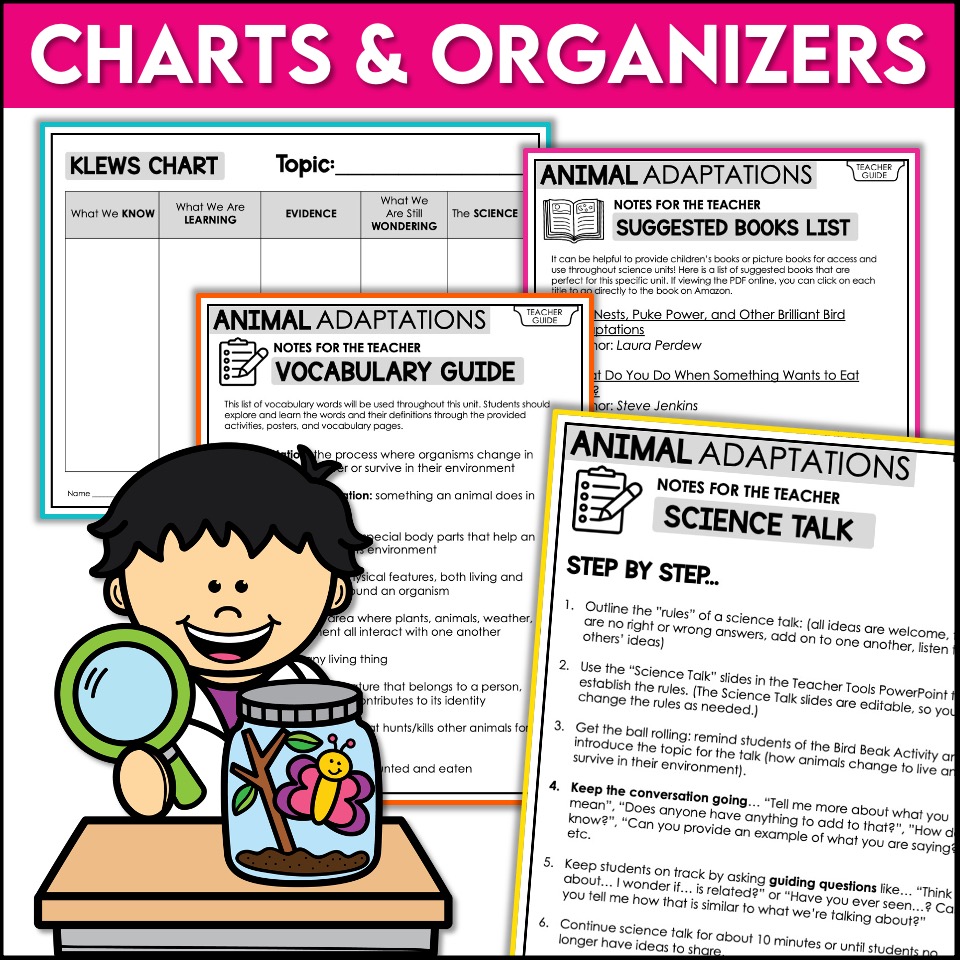
After the beans, students talk. The science talk guide walks you through it step by step: set the rules (all ideas are welcome, add on to each other, listen), get it started with the bird beak results, keep it going with questions like "How do you know?", and wrap up after about ten minutes. The Science Talk slides in the Teacher Tools are editable, so you can change the rules to fit your class.
What students figure out goes on a KLEWS chart (what we Know, what we are Learning, Evidence, what we are still Wondering, and the Science), with a class version to project and a student version to print. There's also a CER template for claim, evidence, and reasoning, and a suggested books list for read-alouds.
Reading passages and worksheets
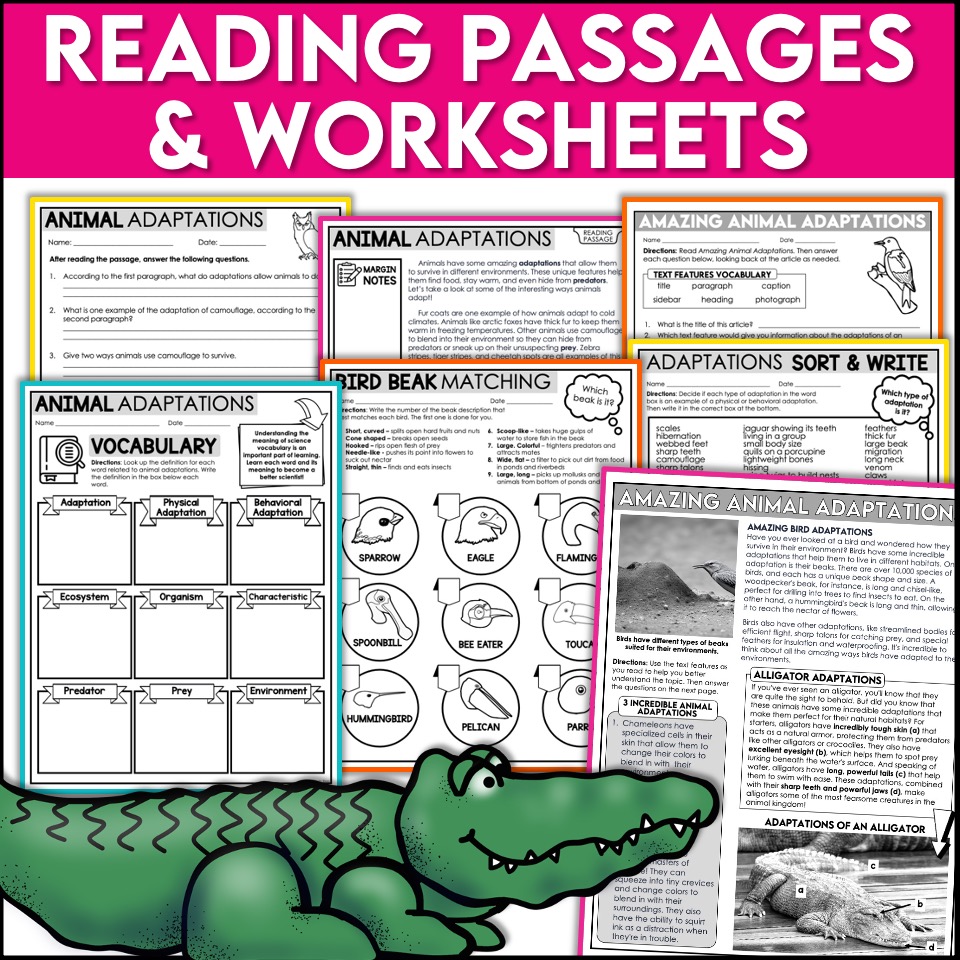
The Animal Adaptations reading passage covers fur coats, camouflage, senses, body shapes, and sharp teeth and claws, with margin notes and a page of questions. The Amazing Animal Adaptations reading activity practices text features with a page on bird adaptations, a page on alligator adaptations with a labeled photo, and a sidebar on chameleons, geckos, and octopuses.
Then there's a vocabulary page, a word search, and the Adaptations Sort and Write, where students decide whether each of 24 adaptations is physical or behavioral, from webbed feet and venom to hibernation and an opossum playing dead. The answer keys are in the back of the unit.
Interactive notebook pages
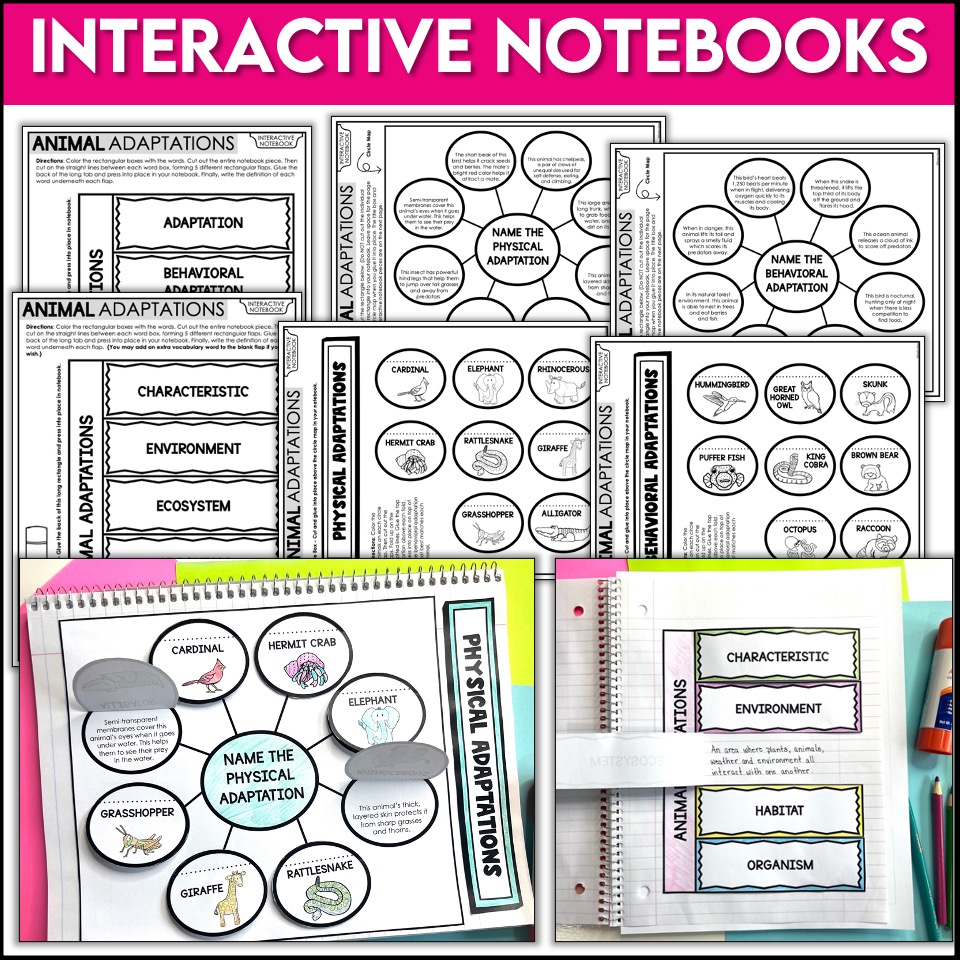
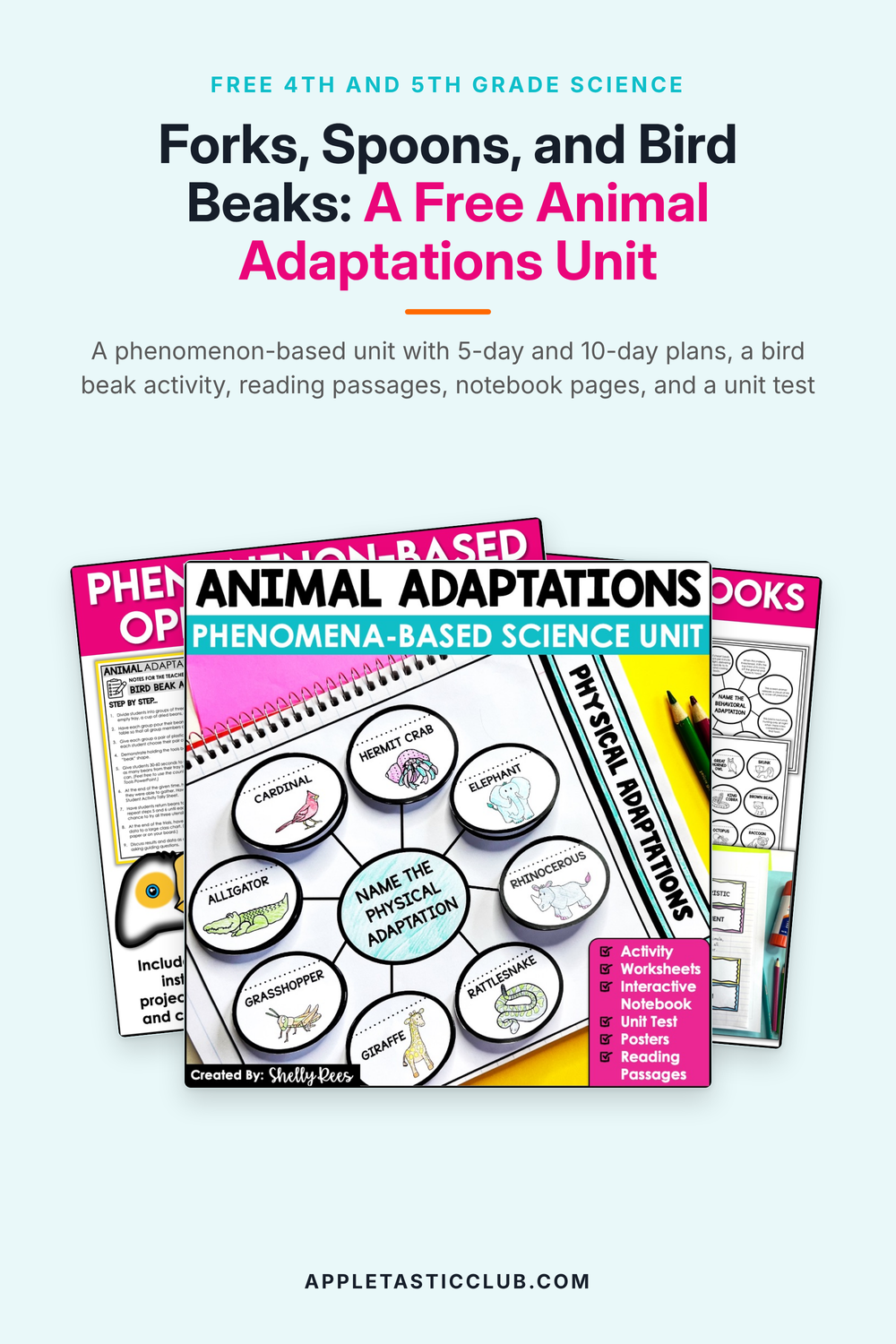
Two vocabulary flap books and two circle maps. On the physical adaptations map, students match clues to the cardinal, hermit crab, elephant, rhinoceros, rattlesnake, giraffe, grasshopper, and alligator. On the behavioral map, it's the hummingbird, great horned owl, skunk, puffer fish, king cobra, brown bear, octopus, and raccoon. A page of photo examples shows students what the finished pieces look like.
Vocabulary posters, notecards, and a unit test
The nine words (adaptation, physical adaptation, behavioral adaptation, environment, ecosystem, organism, characteristic, predator, and prey) come as notecards and as full-page posters in both color and black and white.
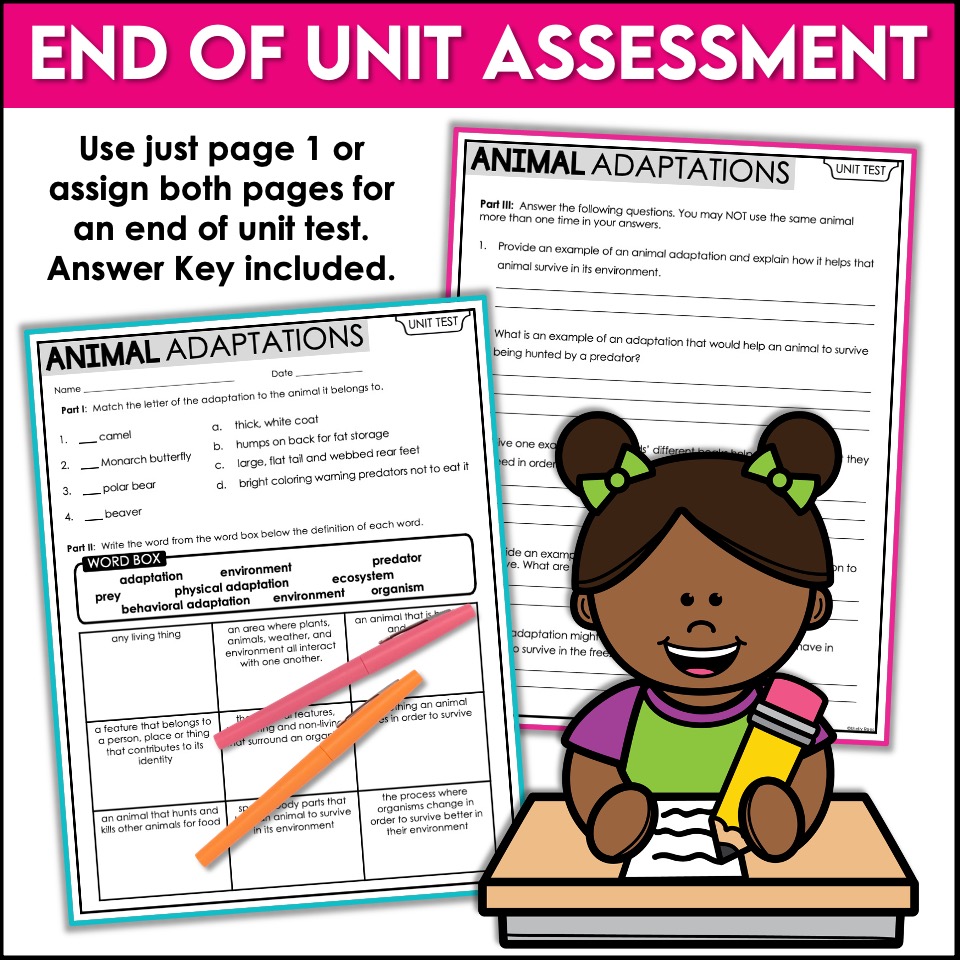
The unit test is two pages. Part I matches four animals to their adaptations, Part II matches the vocabulary to the definitions, and Part III asks five written questions. Use just page 1 for a quick check, or both pages for the end of the unit. The answer key is included.
The one piece that's just for Club members
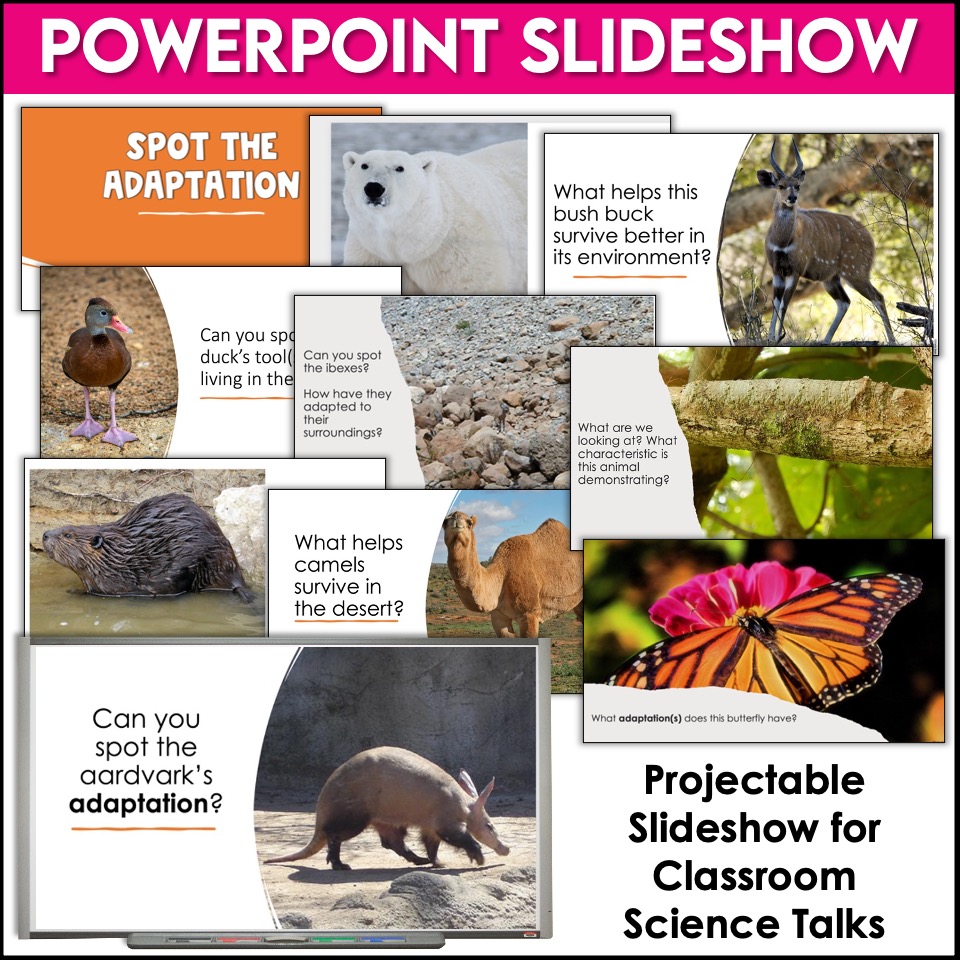
The unit also has a photo slideshow: Spot the Adaptation (the aardvark, the camel, the polar bear, the beaver), a Bird Beaks section with real photos of eagles, flamingos, owls, and woodpeckers, and a drag-and-drop Adaptations and Environments slide. It's the day 3 lesson in both plans. That file is in the Appletastic Club with the rest of the unit, and if you're a member, it's already waiting for you in the Science section.
Here are your free files
Click either one. They open on the downloads page. No email needed.
- Animal Adaptations Printable Unit (PDF, 61 pages: both teacher's guides, the bird beak activity, the science talk guide, KLEWS chart, CER template, books list, vocabulary pages, two reading activities, the sort, interactive notebook pages, the unit test, notecards, posters, and every answer key)
- Animal Adaptations Teacher Tools (PowerPoint: the driving question, the class KLEWS chart, the bird beak tally chart, a countdown timer, and science talk reminders)
More science in the Club
- Animal Adaptations (this unit, plus the photo slideshow, in the 4th and 5th Grade Clubs)
- Plant Adaptations, the companion unit
See everything in the Club, grade by grade
Want the slideshow and every other 4th and 5th grade science unit right now?
The Appletastic Club has over 1,500 resources for 4th and 5th grade teachers: math, reading & ELA, social studies, science, and all the fun stuff, with new ones added regularly. Find what you need, print it, teach it.

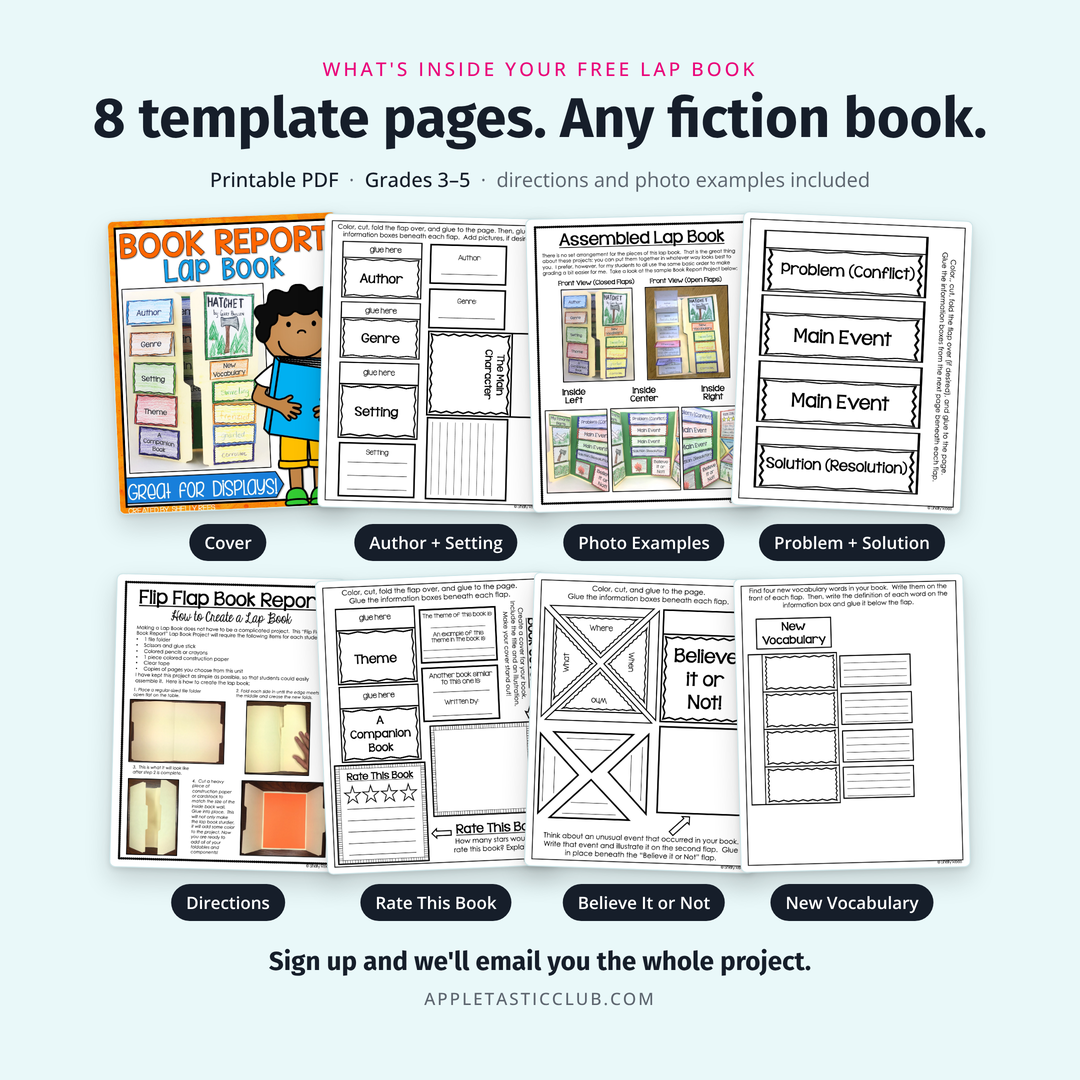
Get the Book Report Lap Book. Free.
A complete book report project for grades 3 to 5, sent to your inbox. It works with any fiction book, and it comes from the same Club this one did.
Pin this for later
Want every resource, ready to teach?
The Appletastic Club has over 1,500 resources for 4th and 5th grade teachers: math, reading & ELA, social studies, science, and all the fun stuff. Find what you need, print it, teach it.
Get the Book Report Lap Book. Free.
A complete book report project for grades 3–5, sent to your inbox. It works with any fiction book.
We are teachers. Your email is safe with us.